
The History of Seville: A Simple Guide to 3,000 Years in Spain’s Soul
Imagine a city where a Roman emperor, a Muslim poet, and the man who funded Columbus’s voyage all walked the same streets. A place where the world’s largest Gothic cathedral shares a wall with a palace built for a Muslim king. For a visitor from distant places, Seville can feel like a beautiful, but confusing, dream. The layers are so deep they seem to blur together.
Where do you even begin to understand a place like this? You begin by letting go of the idea of a single, simple story. The history of Seville isn’t a straight line. It’s a series of powerful moments—of brilliant continuity and dramatic rupture—where one civilization built upon, or completely erased, the one before it. This is not a textbook list of dates and kings. This is a simple framework, designed for a global traveler, to make sense of the incredible monuments you’ll see. It’s the “why” behind the stunning “what.”
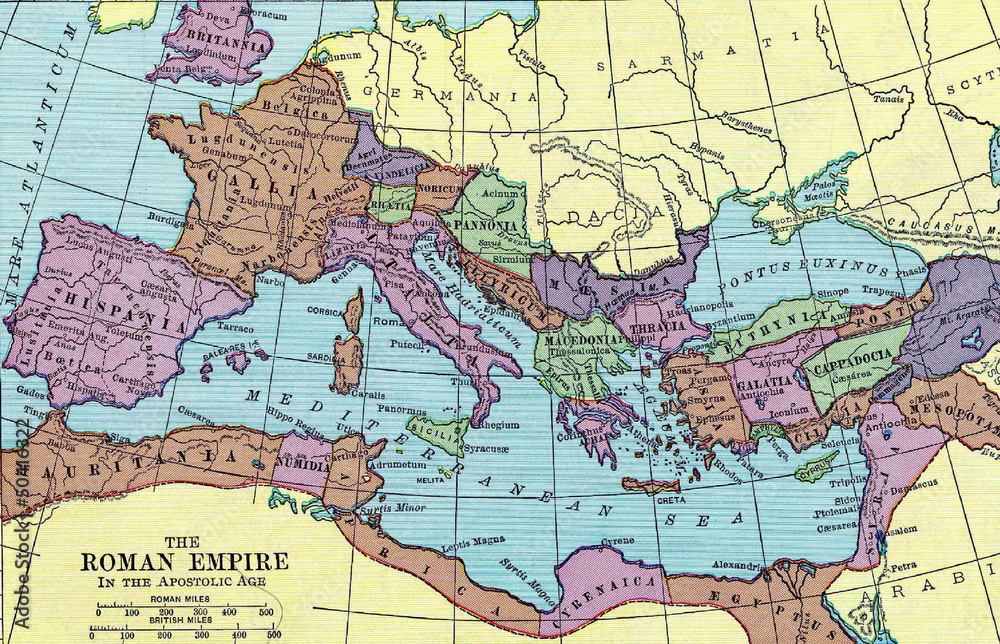
By the end of this guide, you won’t just know that the Alcázar is beautiful. You’ll understand why it looks the way it does. You’ll see the city not as a museum, but as a living argument between its past selves. This is the story we tell on our tours, and it starts not with Spain, but with an empire that spanned from Britain to Iraq.
The First Layer: Rome & The Power of Empire (3rd Century BC – 5th Century AD)
The Rupture: The arrival of a global superpower.
The Continuity: The idea of Seville as a wealthy, planned, cosmopolitan city.
Long before “Spain” existed, the Mediterranean was dominated by Rome. Think of it as the ancient world’s version of a global superpower, with advanced engineering, laws, and trade. When Rome conquered this region, they didn’t just build a military camp. They built a proper, planned Roman city for retired soldiers called Itálica, just outside modern Seville (in Santiponce). It was a statement: “Civilization is here.”
- Why It Matters for You: At Itálica, you can walk on original mosaic floors and sit in a massive amphitheater that held 25,000 people. This wasn’t a local village; it was a mini-Rome, home to not one, but two Roman Emperors (Trajan and Hadrian). It proves Seville’s region was important from the very start of its written history. The city of Seville itself (then Hispalis) was a bustling commercial port on the Guadalquivir River. The Roman obsession with order, grandeur, and public spectacle became part of the land’s DNA.
The Great Rupture: Al-Andalus & The Islamic Golden Age (8th – 13th Centuries)
The Rupture: A complete cultural, religious, and architectural overhaul.
The Continuity: The river’s importance and the love for gardens, water, and intricate beauty.
In 711 AD, a rupture that would define Spain for centuries occurred. Muslim armies from North Africa crossed into Iberia. They called their new territory Al-Andalus, and for over 500 years, Seville ( Ishbiliya) was a leading center of a Muslim kingdom. This was not a dark age. It was a Golden Age of science, poetry, and philosophy, while much of Europe was in its early Middle Ages.
This is the single most important key to understanding Seville’s visual magic. Islamic culture, forbidden from depicting human figures in religious art, perfected geometry, calligraphy, and garden design. Their architecture was about creating cool, shaded, reflective spaces of paradise on earth.
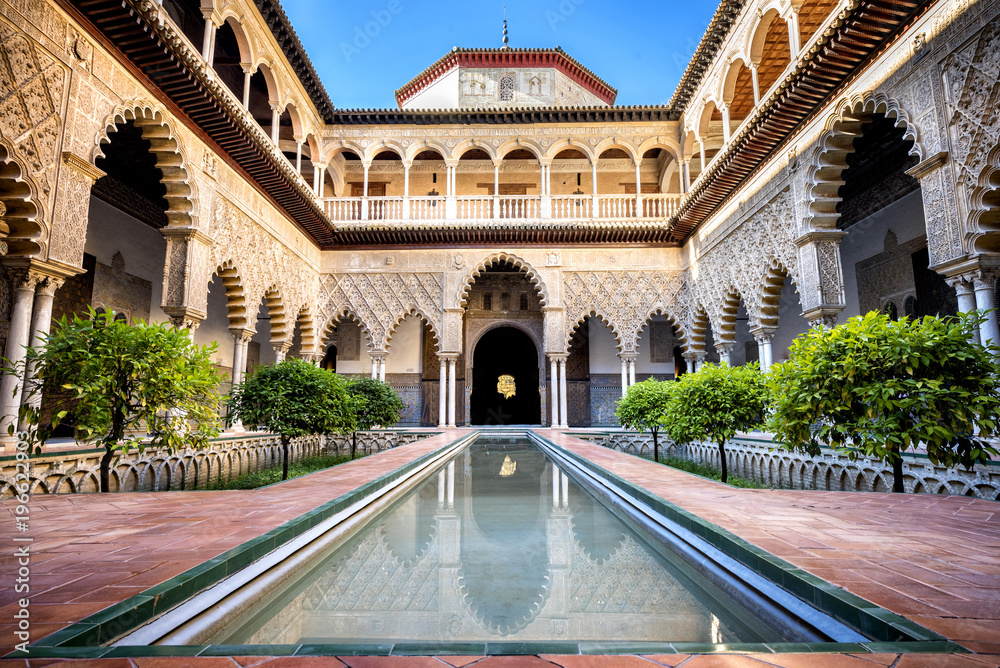
- The Living Proof – The Royal Alcázar (Reales Alcázares): When the Christian kings reconquered Seville in 1248, they didn’t destroy the beautiful Muslim palace. They moved into it. And then they hired the best Muslim craftsmen (mudéjares) to expand it. The Alcázar is therefore not a purely “Islamic” palace, but a Mudéjar masterpiece—a Christian building in an Islamic style. When you stand in the Patio de las Doncellas, you are seeing the direct, unbroken continuity of Al-Andalus’s artistic genius, commissioned by a Christian king. It’s Seville’s first great lesson in cultural blending.
The Christian Reconquest & The Profit of Faith (13th – 15th Centuries)
The Rupture: A change in rulers, religion, and global ambition.
The Continuity: Using existing greatness to project new power.
In 1248, King Ferdinand III of Castile conquered Seville. The Christians were back in charge, but the city’s population was a mix of Christians, Muslims, and a large Jewish community. The new rulers segragated the Jewish population into a walled quarter.
- The Living Proof – The Santa Cruz Neighborhood: Today’s charming Barrio de Santa Cruz, with its flower-filled patios and narrow lanes, was once that Jewish quarter (Judería). Its layout still echoes its past. After the Jews were expelled in 1492, it became a poor neighborhood, before being prettified in the 20th century. Walking here is walking through layers of displacement and reinvention.
The Christian kings immediately started building the ultimate symbol of their triumph right on the city’s main mosque: the Seville Cathedral.
- The Living Proof – The Cathedral & La Giralda: They tore down the mosque… but kept its magnificent minaret. They simply added a bell tower on top, creating La Giralda, the city’s most famous symbol. The Cathedral itself is a staggering statement: “Our God is greater.” They built the largest Gothic cathedral in the world, a forest of stone meant to awe and intimidate. It’s a perfect metaphor: a Christian shell built around a Muslim heart, using sheer scale to declare a new era.
The Big Bang: Seville Rules the World (16th – 17th Centuries)
The Rupture: Seville becomes the center of a global economic system.
The Continuity: The river as the source of all wealth.
In 1492, two world-changing events happened: the final defeat of Muslim Granada and Christopher Columbus’s first voyage. The Spanish monarchs gave Seville an incredible monopoly: all trade with the new Spanish Empire in the Americas had to flow through this city.
For 200 years, Seville was the Wall Street, Silicon Valley, and Singapore of its day. Silver from Peru, chocolate from Mexico, and silk from China flooded in. The river port exploded with activity.
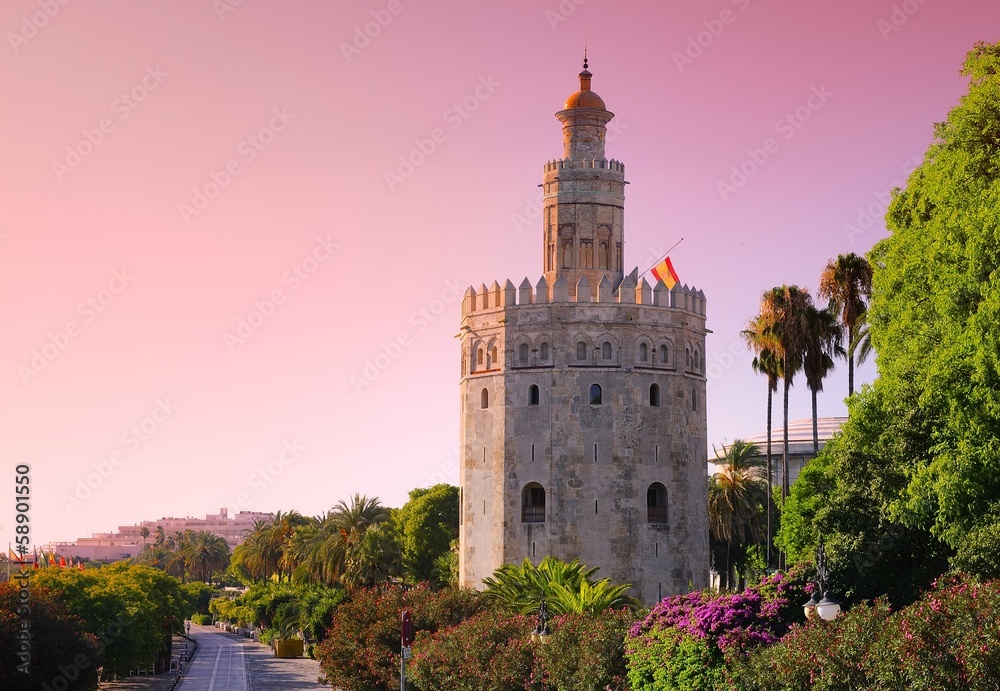
- The Living Proof – The Archive of the Indies & The Torre del Oro: The Torre del Oro (Tower of Gold), a 13th-century Muslim watchtower, now guarded a river jammed with treasure ships. To manage this empire of paper, the majestic Archive of the Indies was built. Today, it holds maps of Manila, letters from Columbus, and plans for California missions. These buildings are the physical remnants of the first truly global economy, and Seville was its capital.
- The Living Proof – Triana: Across the river, the Triana neighborhood thrived. This wasn’t a pretty postcard then; it was a tough, bustling port district. Here lived the sailors, potters, and gypsy communities who built the ships and supplied the voyages. Triana developed a fierce, independent identity that it still has today—the soulful counterpoint to the official power across the water.
The Slow Decline & Romantic Reinvention (18th – 19th Centuries)
The Rupture: The loss of the trade monopoly and wealth.
The Continuity: The city’s spirit of adaptation and theatrical beauty.
The empire moved on. The Guadalquivir silted up, big ships couldn’t reach the city, and the trade monopoly shifted to Cádiz. Seville grew poor. But in the 18th century, it got a new, strange industry: tobacco.
- The Living Proof – The Royal Tobacco Factory: The Real Fábrica de Tabacos was one of the largest industrial buildings in Europe. It’s now part of the University, but its scale shows a last attempt at imperial industry. It’s also famous as the workplace of Carmen, the fictional gypsy tobacco worker from Bizet’s opera, symbolizing Seville’s new image in the European imagination: not a power center, but a place of passion, drama, and romance.
Modern Seville: Staging Its Own History (20th – 21st Centuries)
The Rupture: The need to create a “brand” for tourism and modern identity.
The Continuity: The endless recycling of its own past for the present.
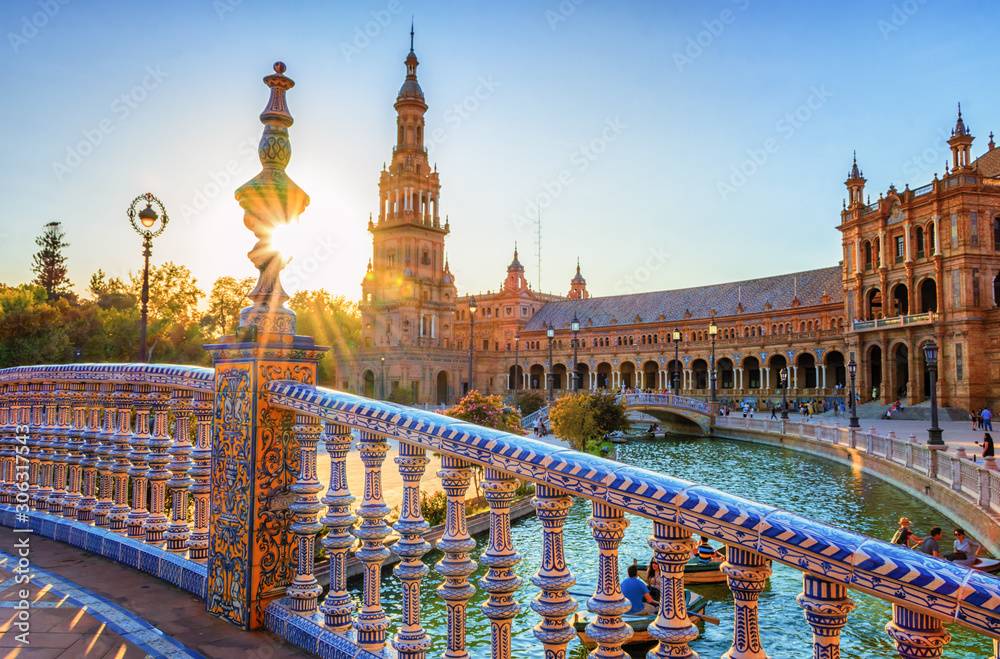
The 20th century saw Seville consciously reshape its history into a show. For the 1929 World’s Fair, it built the stunning Plaza de España, a movie-set version of Spanish Renaissance style. For the 1992 World’s Fair, it cleaned up its river and reclaimed industrial land.
Modern Seville doesn’t hide its layers; it stages them. The Metropol Parasol (“Las Setas”), the world’s largest wooden structure, sits atop Roman ruins you can visit below. It’s a perfect modern symbol: respecting the past while building something utterly new on top of it.
How to See Seville’s History in Just 3 Monuments (A Simple Framework)
To keep it simple, remember this trio:
- The Alcázar: Represents the Islamic Golden Age and its beautiful, enduring influence on art and life.
- The Cathedral: Represents the Christian Reconquest and the overwhelming power of the Church and monarchy.
- The Archive of the Indies: Represents the Global Empire, the moment Seville connected Europe to the Americas and became the center of the world.
Everything else—the winding streets of Santa Cruz, the proud vibe of Triana, the solid bulk of the Tobacco Factory—fills in the human stories around these three pillars of power, faith, and money.
The City That Never Erased, Just Built Over
Seville’s history isn’t about choosing one layer over another. It’s about understanding the conversation between them. A Muslim minaret becomes a Christian bell tower. A Jewish quarter becomes a tourist highlight. A palace for Muslim kings becomes the residence of the Spanish royal family. An industrial factory becomes a university.
This is what makes Seville unique. It didn’t erase its past; it absorbed it. The city is a palimpsest—a parchment where old writing shows through under the new. For a visitor from a younger country, this can be the most thrilling lesson: history here isn’t in a museum case; it’s the pavement under your feet, the wall next to the café, the reason a street curves in a certain way.
This simple framework is just the beginning. Every street, plaza, and tile has a story that bends this grand narrative. This is where a local guide makes all the difference. We can point to a wall in the Alcázar and show you the Christian symbol hidden in the Islamic plasterwork. We can walk you through Triana and explain how the echo of shipbuilders shaped the sound of flamenco.
You’ve now got the map. Let us help you navigate the territory.
Ready to see the conversation between empires, faiths, and cultures for yourself? Join our us, where we connect these dots in real time, turning the city’s streets into an open history book written in stone, brick, and soul.